Features

Every module, in detail.

Servio is six modules on one login and one database. Here's what each one does.

Panel

Nodes and game servers, and the base for bots and websites too.
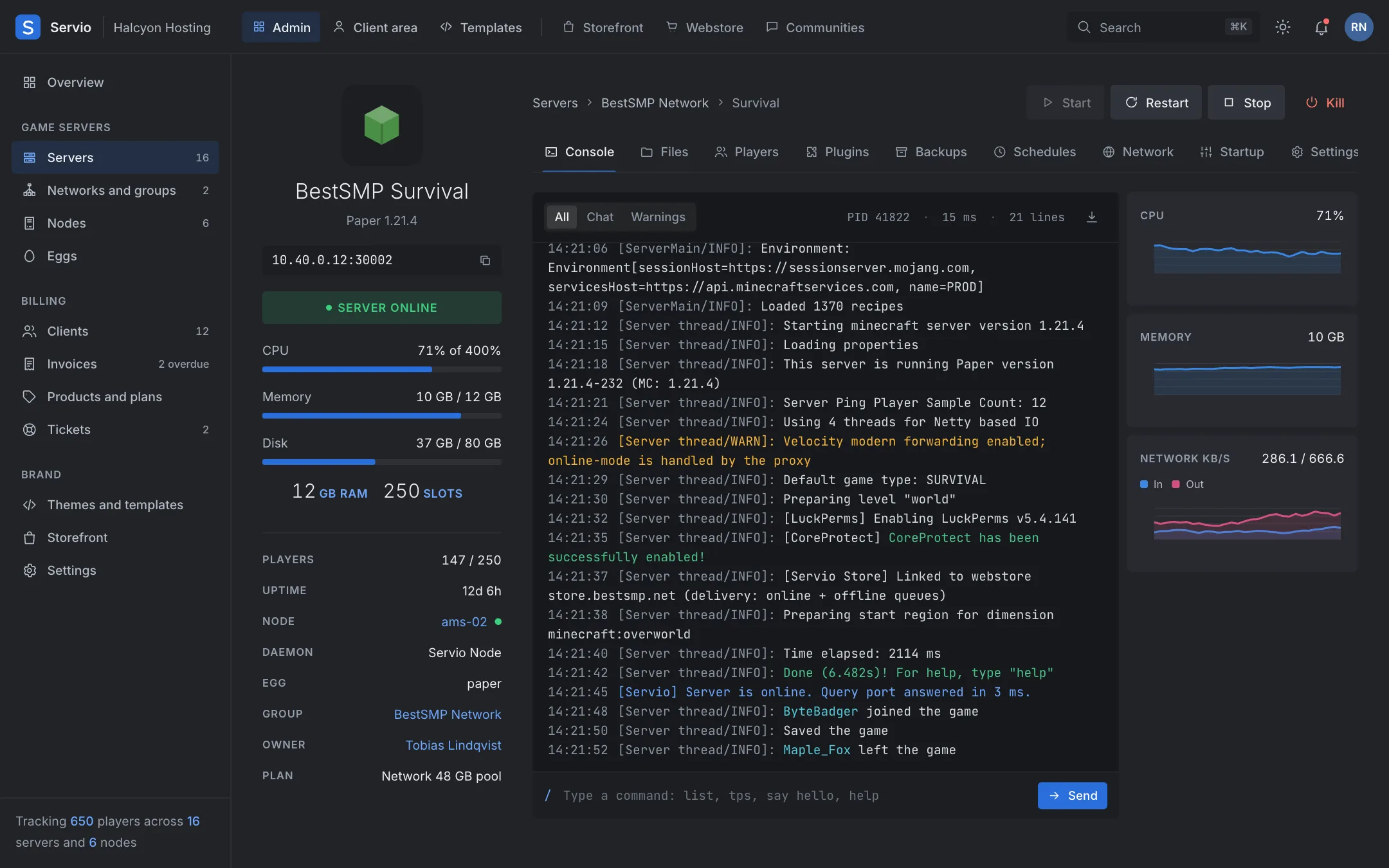
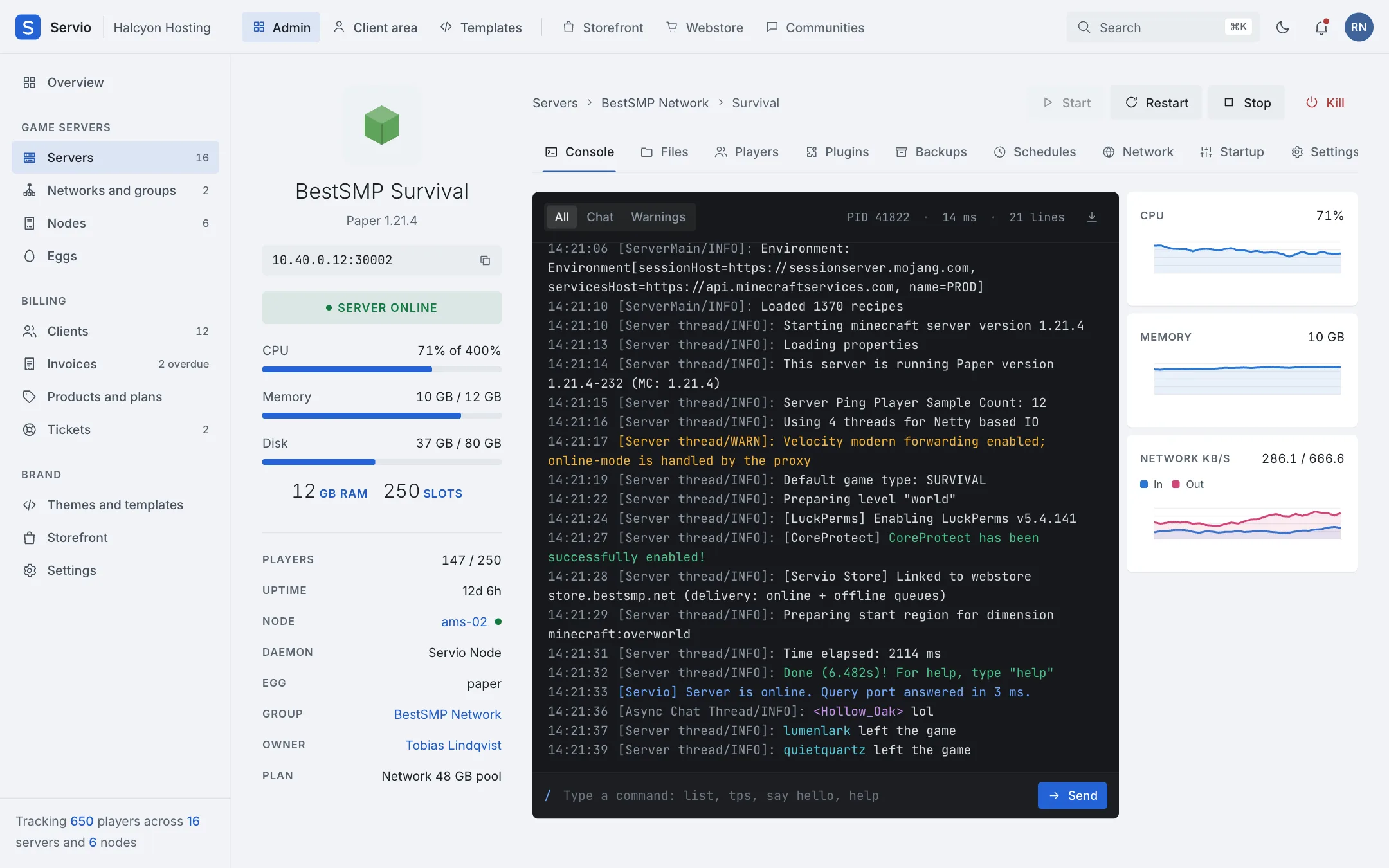
  • Console: a live WebSocket stream with ANSI colors, command history, filters for chat and warnings, and command rules per person.
  • Files: browse, edit, rename, upload and download, with a code editor. SFTP on every node.
  • Backups: compressed archives on the node, restore, lock and download, on the node or in S3-compatible storage.
  • Schedules: cron with commands, power actions, backups and in-game countdowns.
  • Players: who's online from console lines, with kick, ban, op and say.
  • Crash records and restart backoff, so a crash loop doesn't burn a node.
  • Networks and groups: a Velocity or BungeeCord proxy and its backends with a shared player count, ordered power and a live map.
  • Audit log of every action, and ⌘K search across everything.
A server's console with its info rail and resource graphs.A server's console with its info rail and resource graphs.

Bots and websites

A network is more than its game servers. Bots and websites run on the same nodes, in the same hardened containers, with the same limits and firewall.

Bots

  • Discord, Telegram, Twitch and other bots as their own server type.
  • Eggs for Node.js, Python, Java, Go and Bun.
  • Deploy from Git, environment secrets, auto-restart and logs.

Websites

  • A landing page, a wiki or a status page for your network.
  • Static, PHP, or Node apps such as Next.js.
  • Each site on its own domain with automatic TLS. Deploy by upload or Git.
  • Web traffic goes through the panel or node proxy, not raw ports.

Storage, CDN and databases

The services your servers, bots and sites lean on. Attach one and its connection details arrive as environment variables. Hosting companies can sell each of them as a plan.

Storage

S3-compatible buckets and access keys, for backups, maps, resource packs and uploads.

CDN

Cached public delivery from buckets and sites, image resizing and custom domains.

Databases

MySQL or MariaDB, PostgreSQL and Redis, managed, with a web console.

Cron and workers

Scheduled jobs and background workers next to the apps that need them.

Friends

For the self-hoster whose friends keep asking for a restart.
  • Invite by link. They make an account; nothing else to set up.
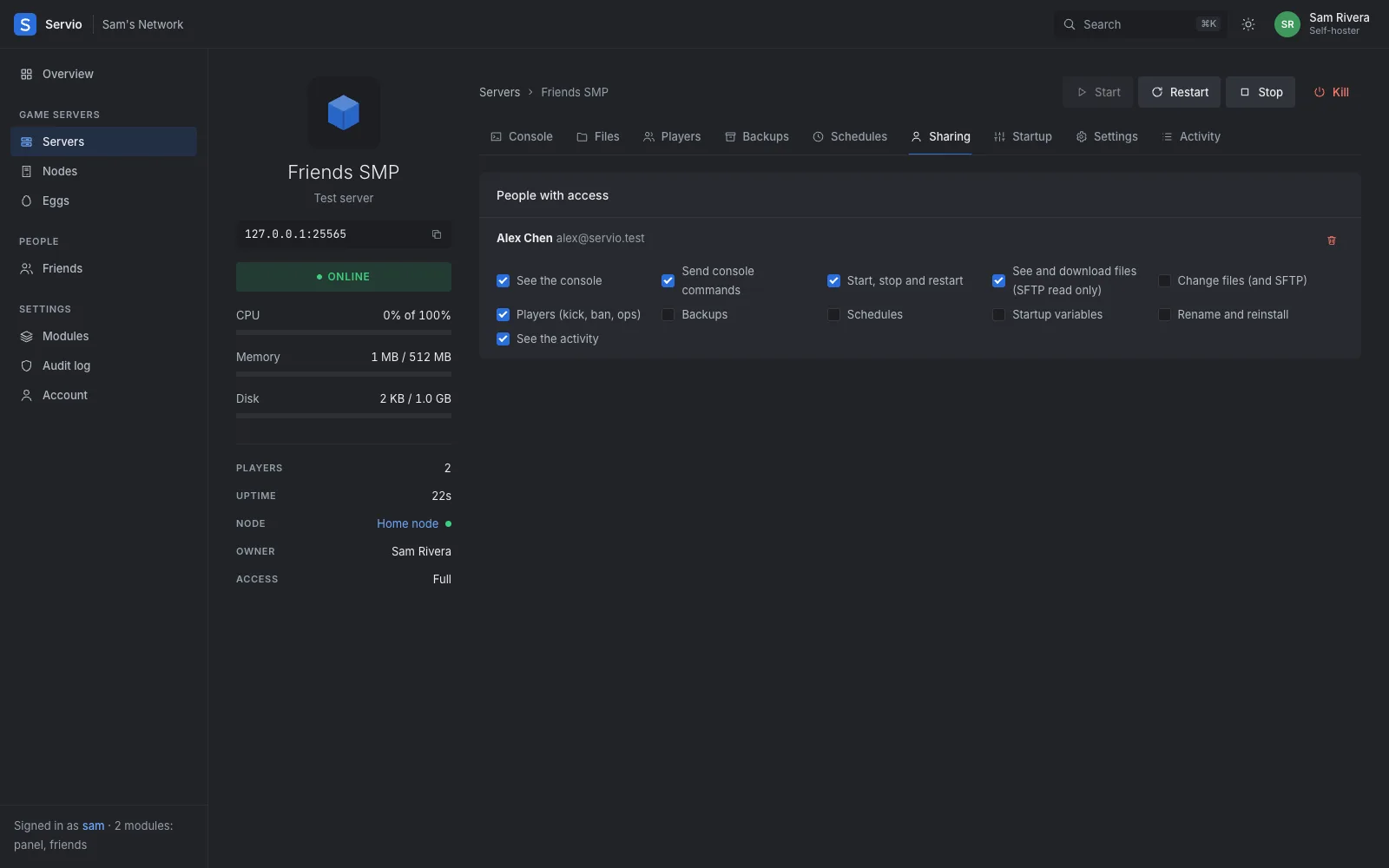
  • Share one server or several, and tick what each friend may do: console, commands, power, files (read or write), players, backups, schedules, startup, settings and activity.
  • Friends see only what you shared with them. Everything else simply doesn't exist for them.
  • Free on the Personal tier: up to 3 nodes and 50 servers.
Sharing settings for one server: a friend with console, power, files and players ticked.

Hosting

Sell game servers end to end: from a plan to a running server and an invoice.
  • Sell more than game servers: bot plans, web hosting, storage, CDN and databases, next to your game plans.
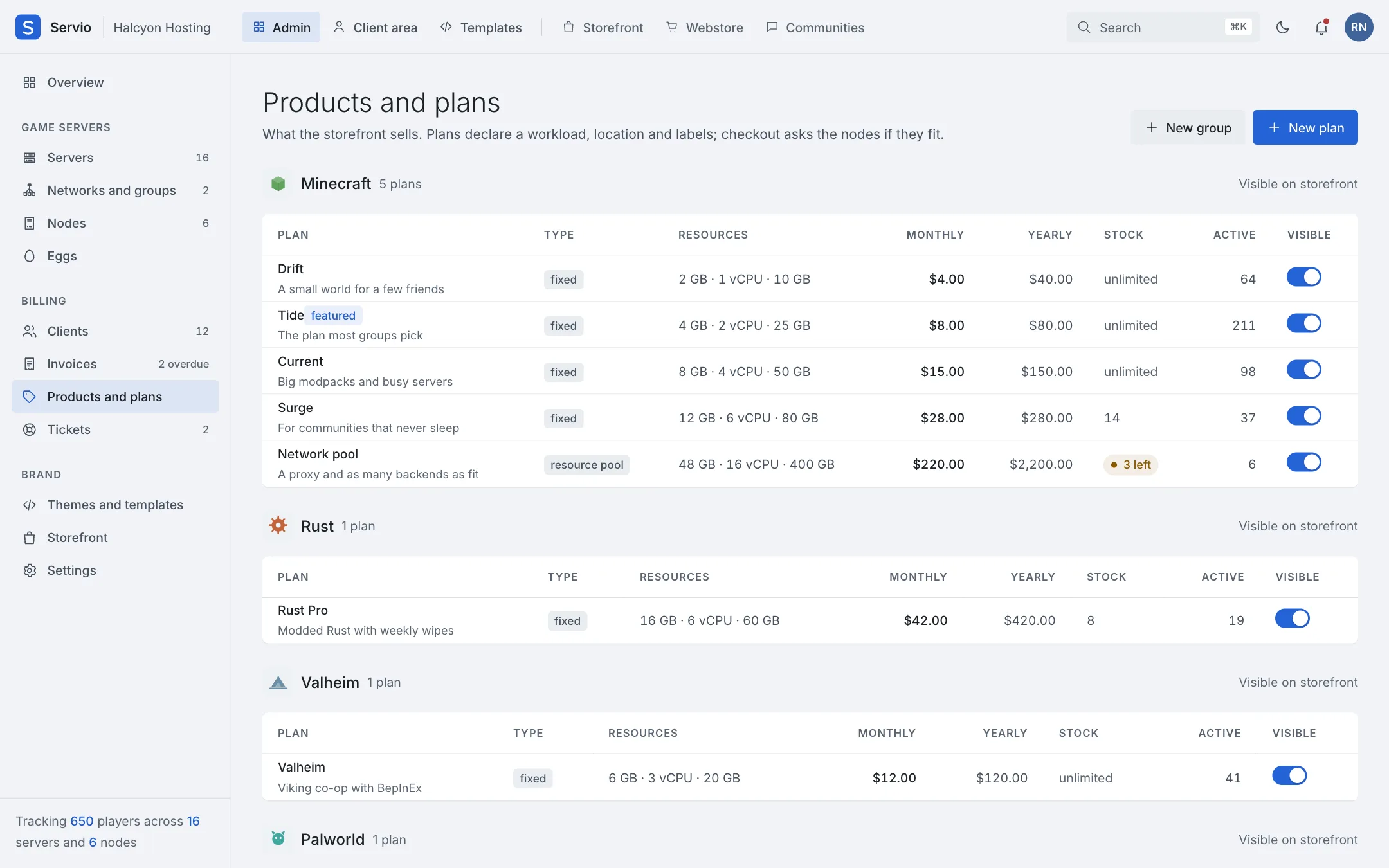
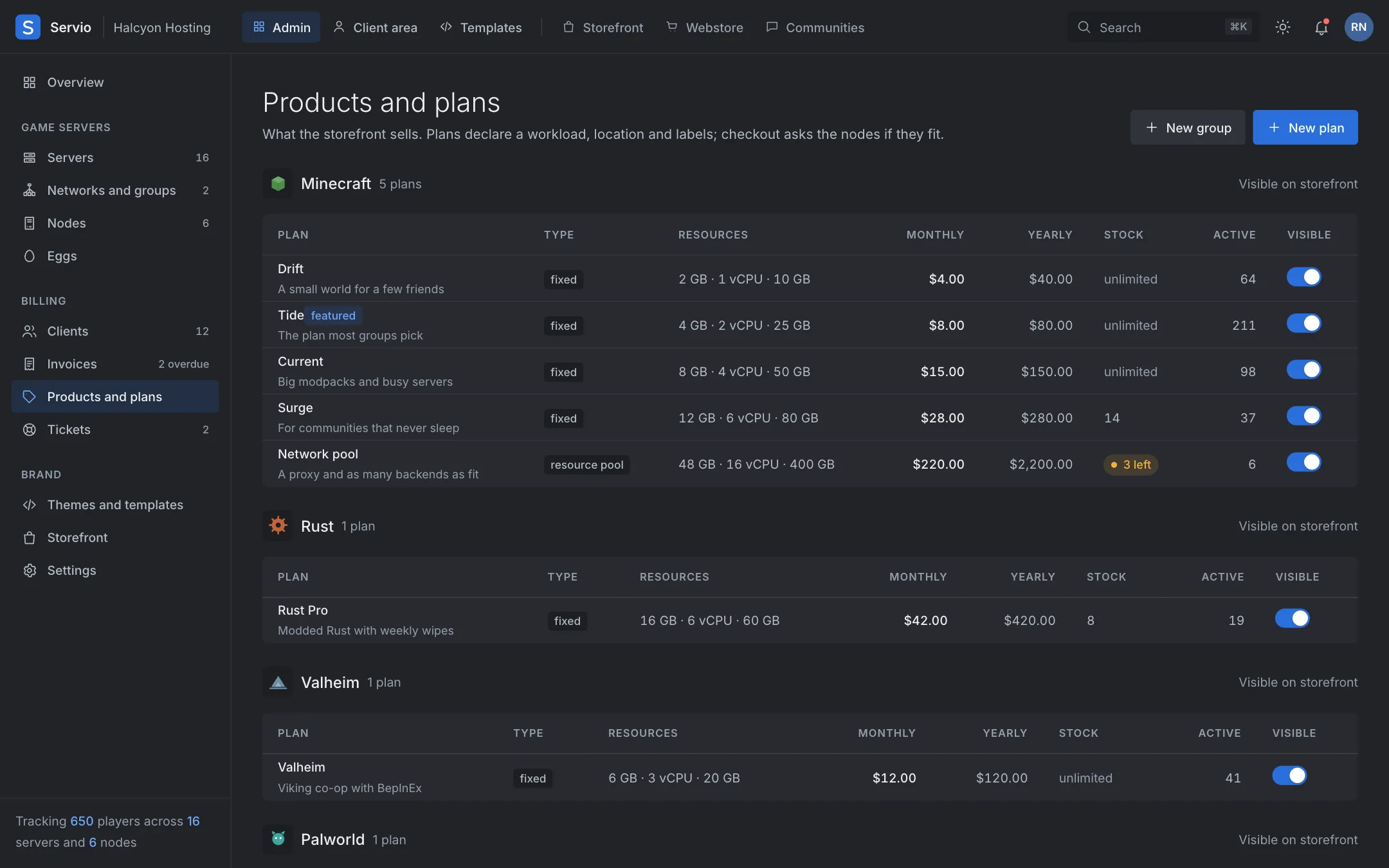
  • Products: fixed plans or resource pools, configurable options priced per step, add-ons, setup fees, trials and stock.
  • Invoices with per-brand numbering, credit, tax per country and PDF. Published invoices never change; corrections are credit notes.
  • Automation: renewal invoices, reminders, suspension and termination after the days you set, dunning with saved cards.
  • Gateways: Stripe, PayPal, bank transfer, a merchant-of-record option and crypto through BTCPay Server.
  • Client area: services, invoices, payment methods, tickets, and each service's panel inline.
  • Resellers and multiple brands, each with its own domain, theme, currency and Stripe.
  • Free sites for clients: your plans can include a webstore and a forum for each client's community.
Products and plans for a hosting company, with prices, resources and stock.Products and plans for a hosting company, with prices, resources and stock.

Storefront

Your hosting company's public site, where people pick a plan.
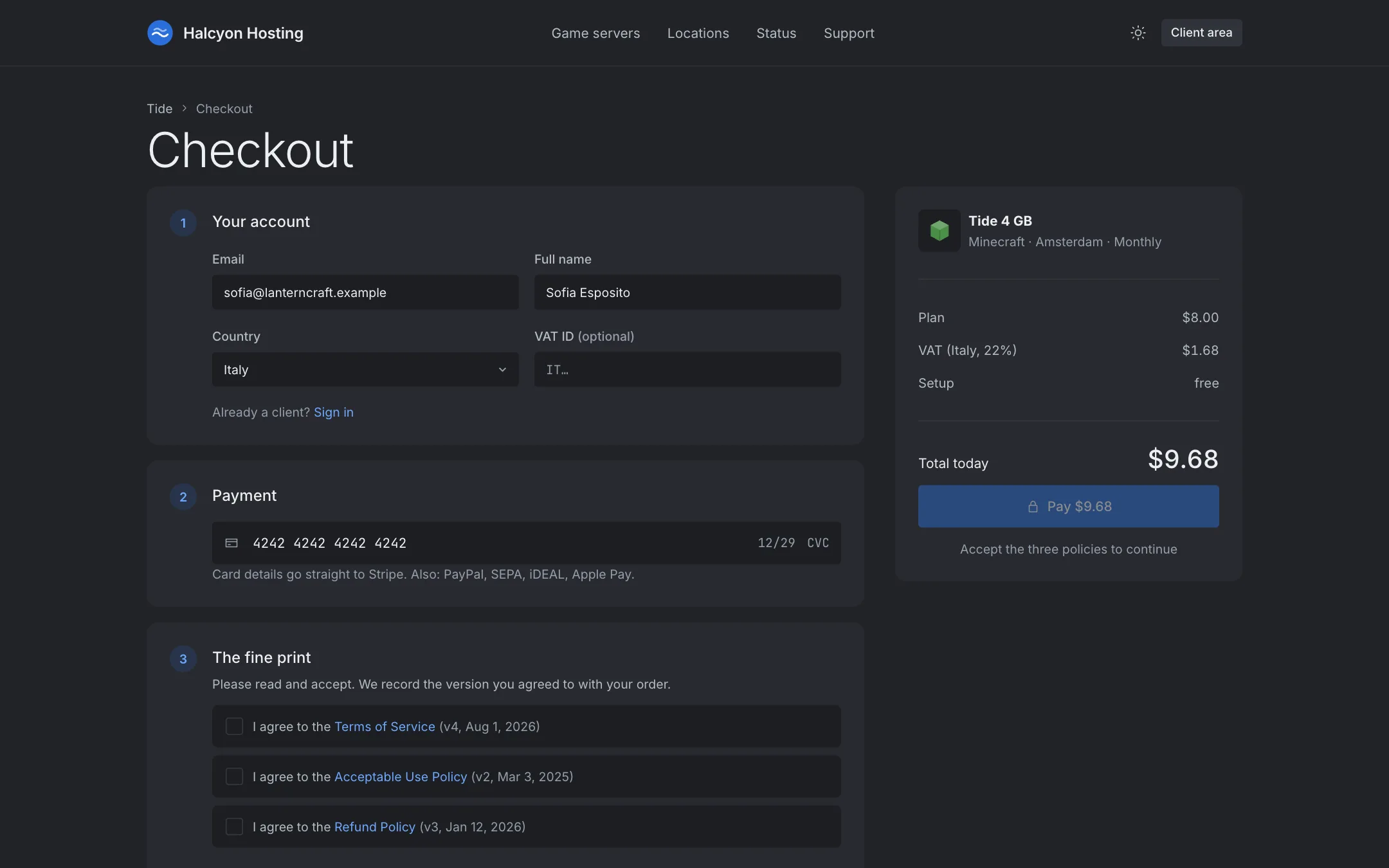
  • A game landing template: hero with a "from" price, plan cards or a per-GB slider, features, FAQ and locations.
  • A game picker that also lists Bots and Websites, for hosts that sell them.
  • A one-page configurator with a sticky summary: billing cycle, location, version and add-ons.
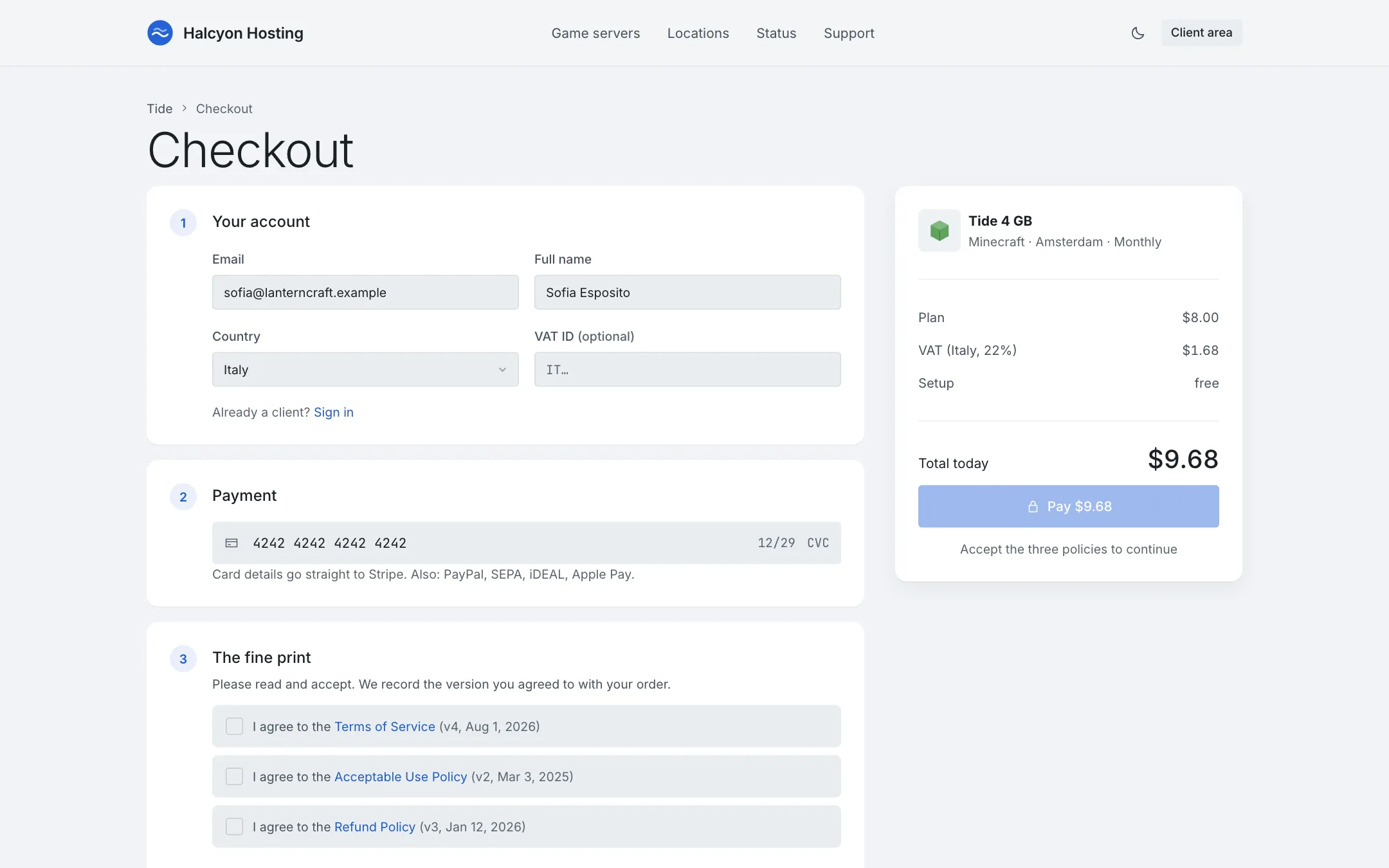
  • Legal pages per brand (terms, privacy, refunds, SLA) with versions, and acceptance recorded on each order.
  • Trust numbers only from real data: measured uptime, servers deployed, ticket response times.
  • Every page is a template you can edit, with live preview and version history.
A storefront checkout with a plan, billing cycle, location and the policies to accept.A storefront checkout with a plan, billing cycle, location and the policies to accept.

Webstore

An in-game store for ranks, keys and perks. On its own or next to the Panel.
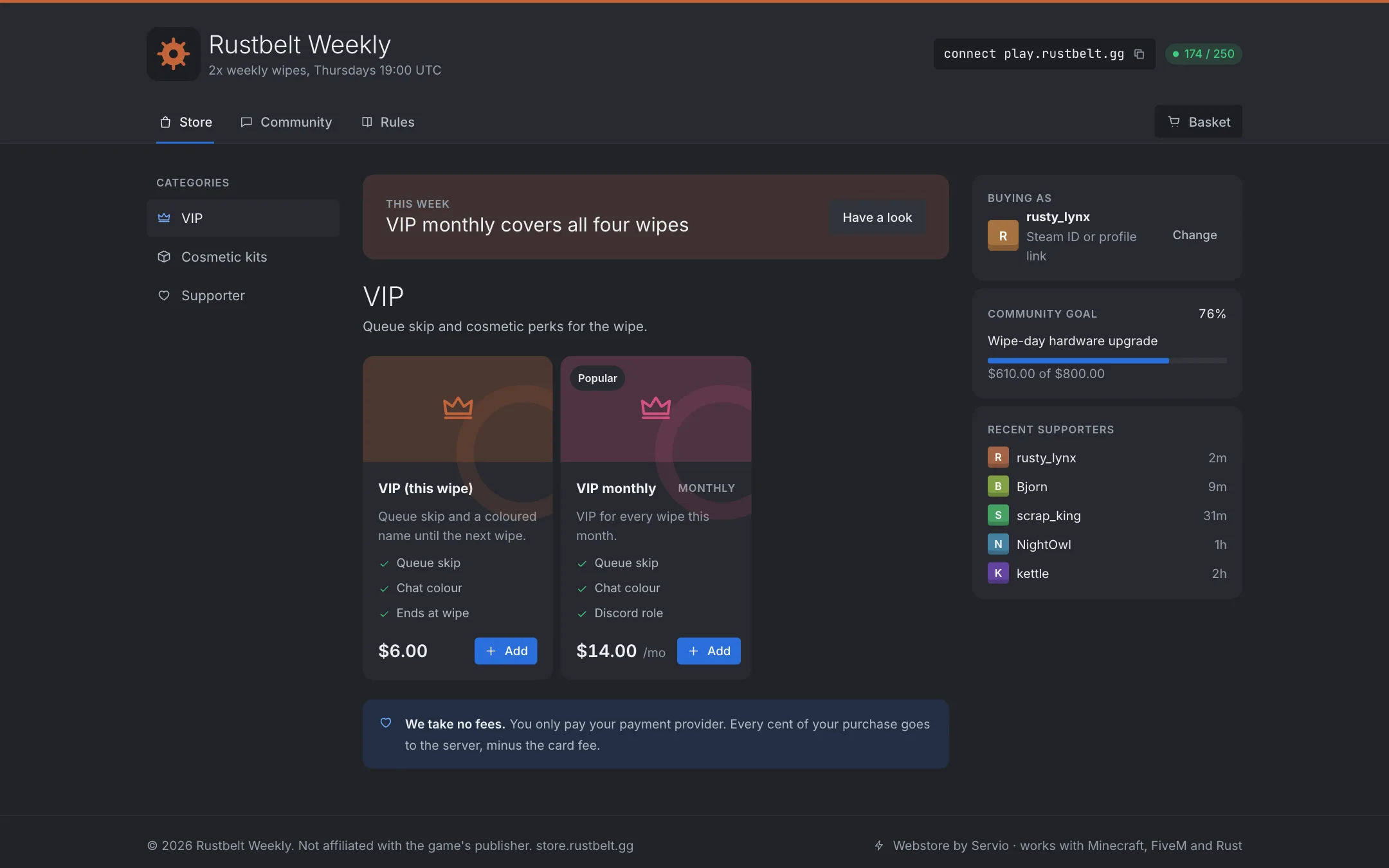
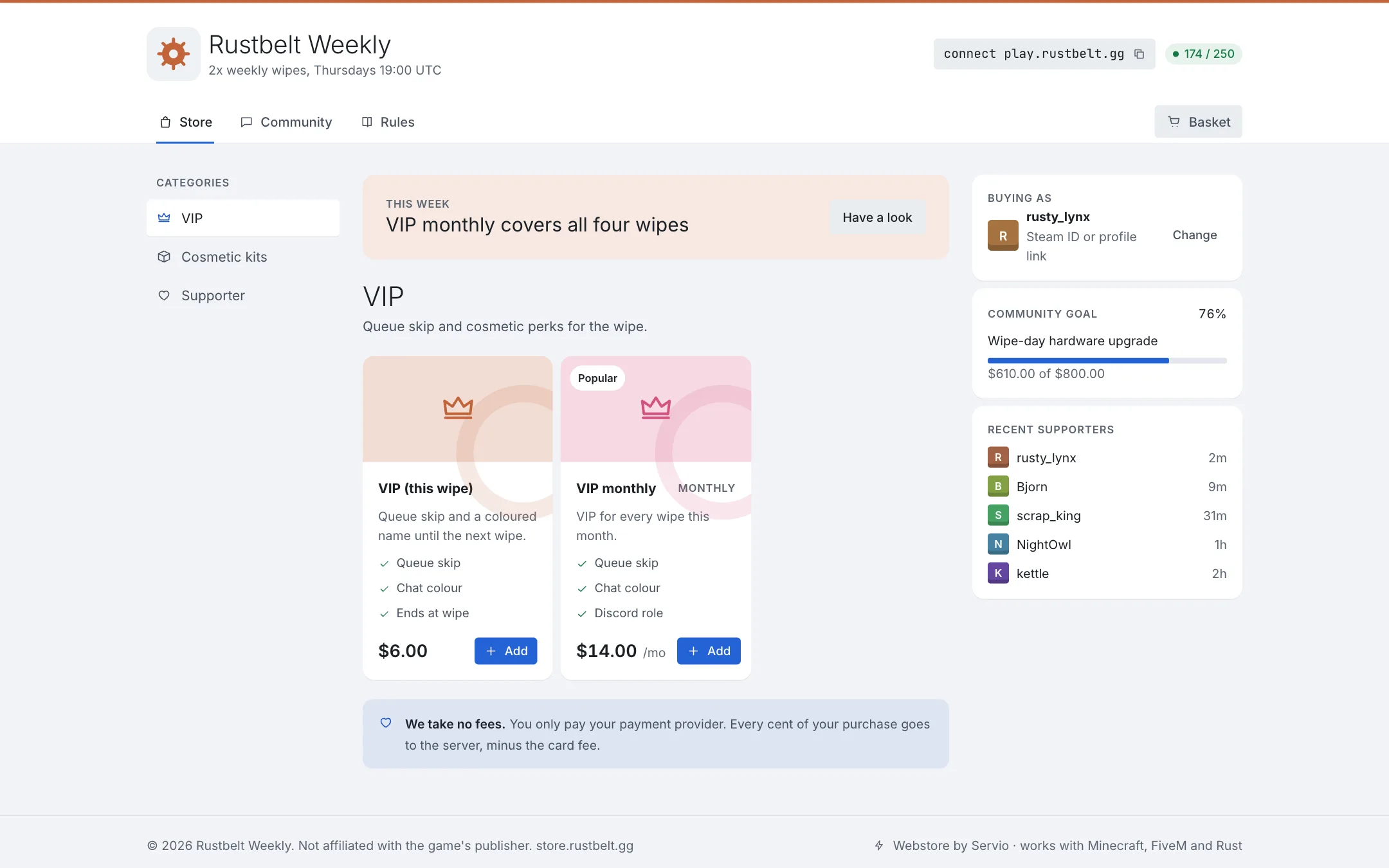
  • Packages: one-off, subscriptions and tiered upgrades that charge the difference.
  • Sales, coupons, gift cards, creator codes, bundles and community goals.
  • Checkout without an account: a player name, Steam ID or Cfx.re account and an email for the receipt.
  • Delivery through a command queue with online and offline commands, delays, retries and a log per purchase.
  • Open-source plugins for Minecraft, FiveM and Rust. No plugin needed for servers hosted on Servio.
  • Read more about the Webstore
A Rust webstore with kits and VIP packages.A Rust webstore with kits and VIP packages.

Communities

Forums for your players, on your own domain.
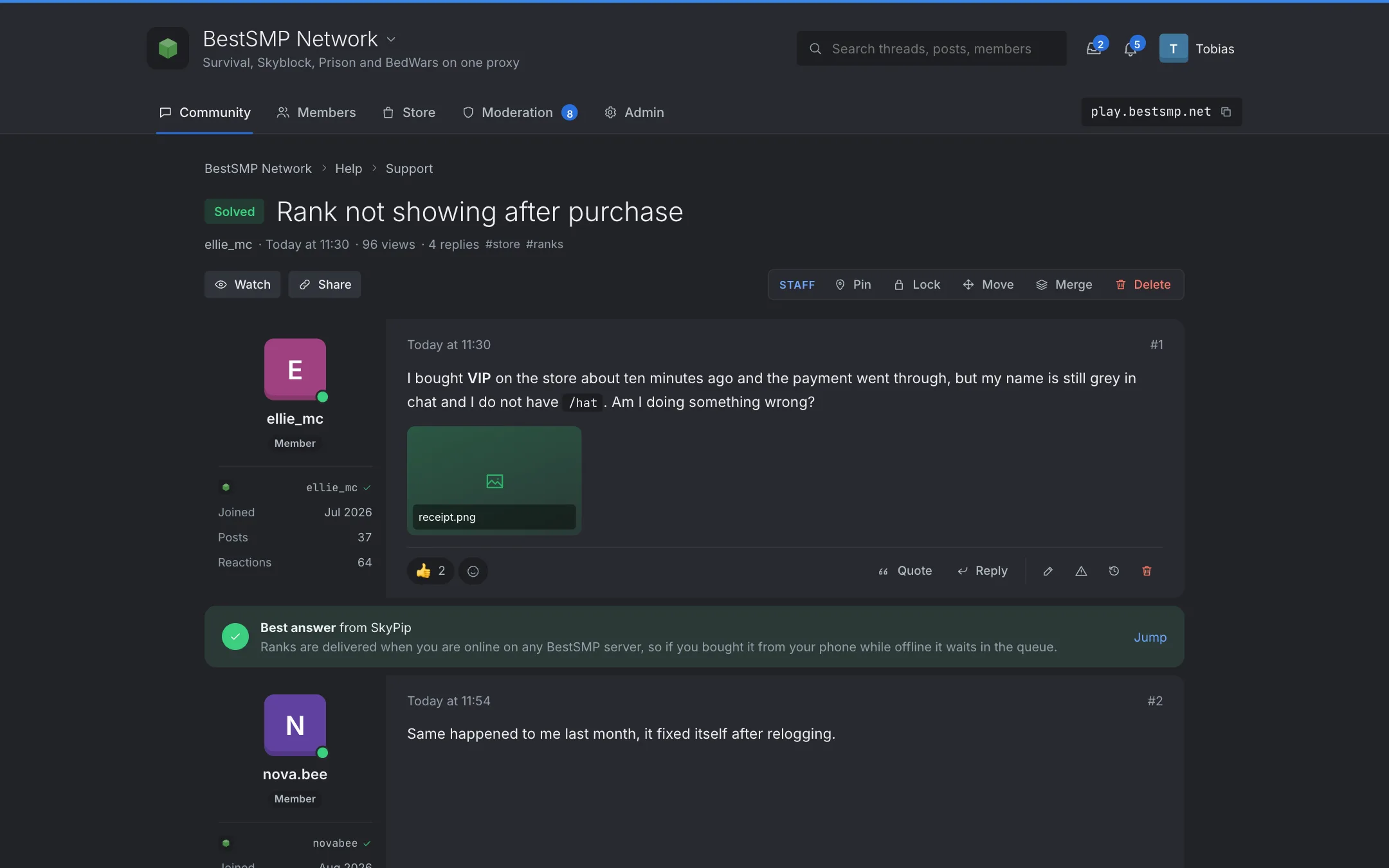
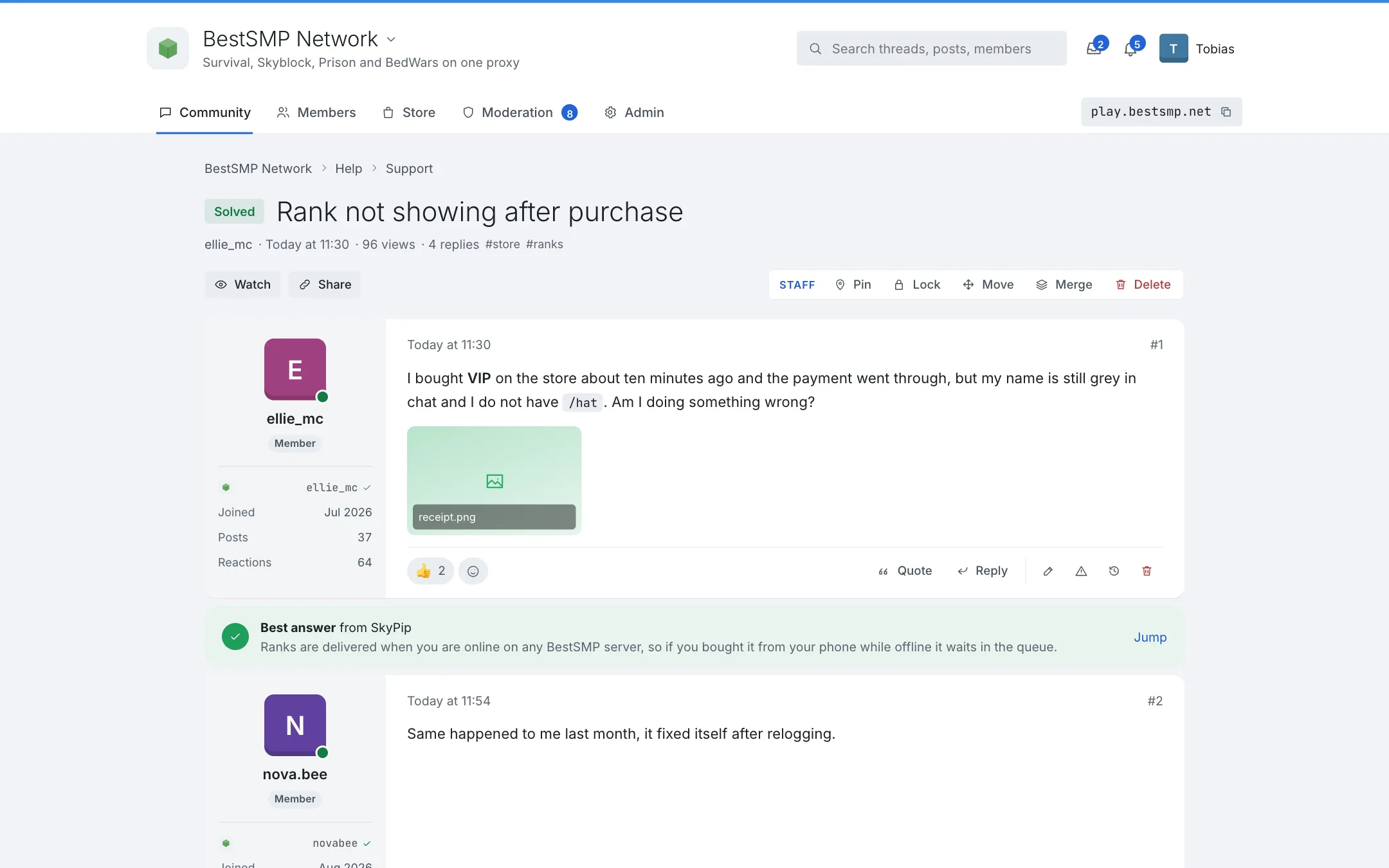
  • Boards, threads, polls, best answers, reactions, mentions and attachments.
  • Alerts, watched threads and private conversations.
  • Roles and per-board permissions, with a matrix that shows where each value came from.
  • Moderation: approval queue, reports, warnings with points, bans and an audit log.
  • Store-linked roles: buying a rank adds a badge and private boards, and removes them when it expires.
  • Read more about Communities
A support thread with a best answer, reactions and a staff badge.A support thread with a best answer, reactions and a staff badge.

Nodes and daemons

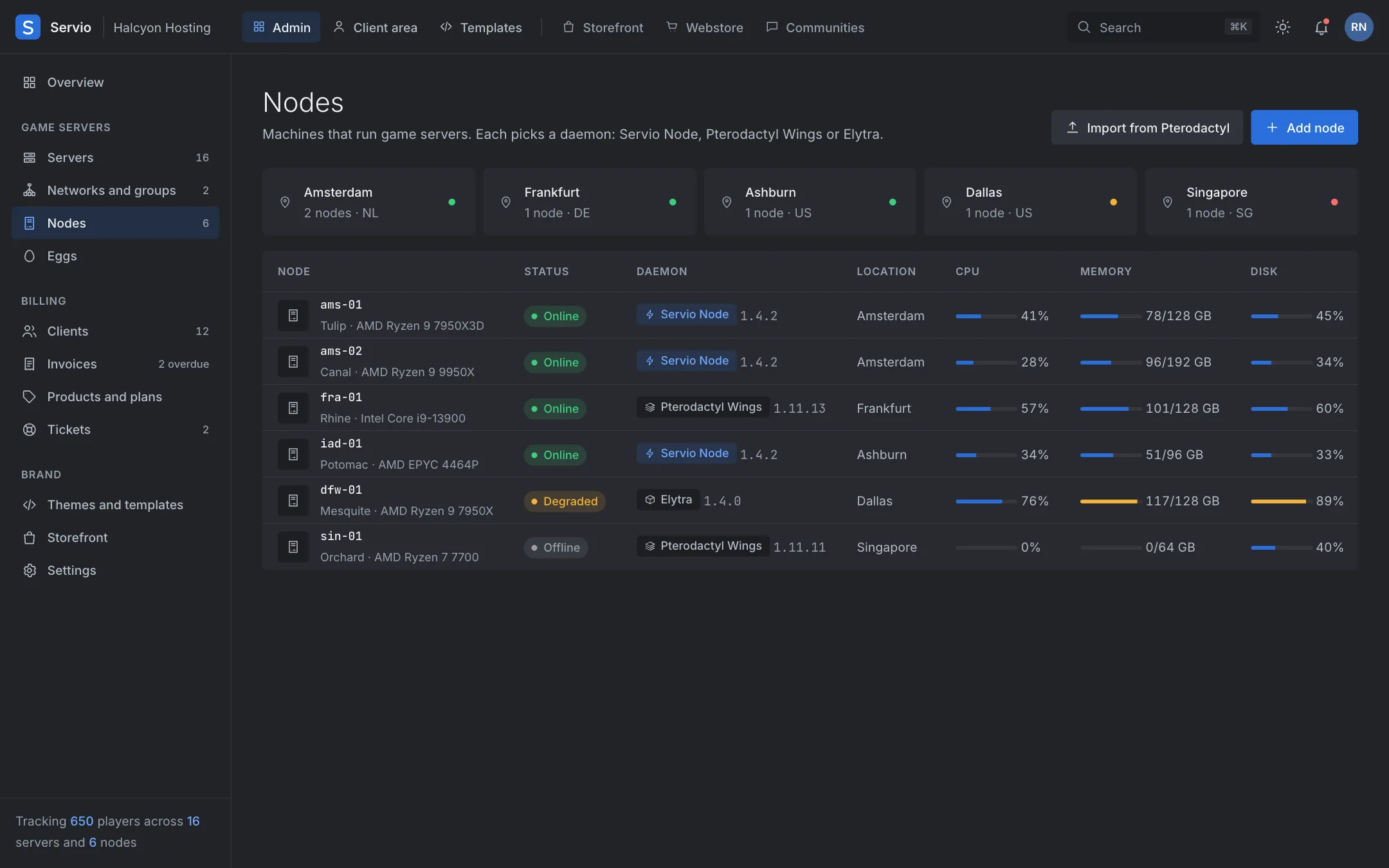
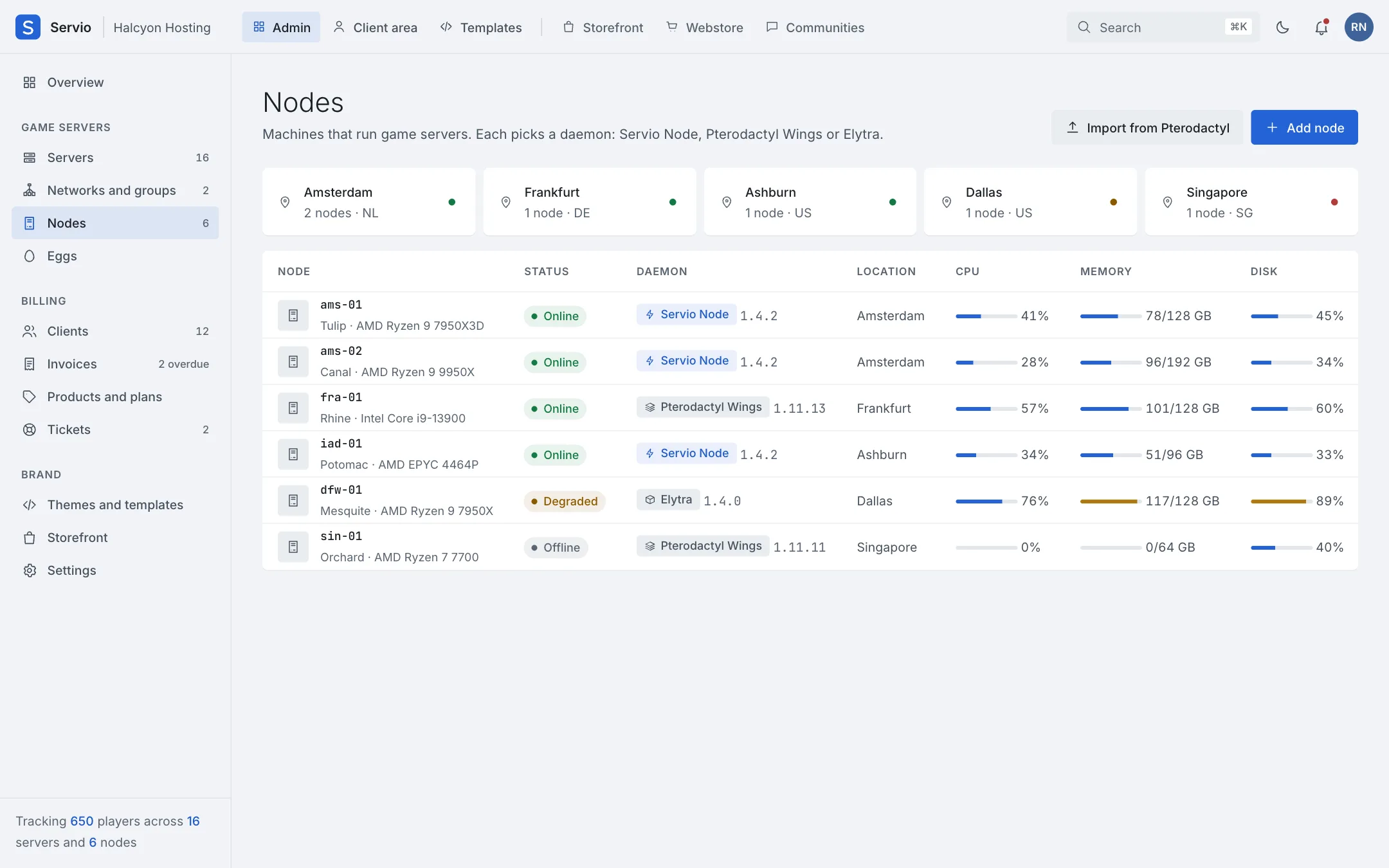
A node is a machine with Docker that runs game servers. Each node runs a daemon, and you choose which one. The panel shows what each daemon can do on the node and server pages, so nothing fails quietly.

What each node daemon supports
FeatureServio NodePterodactyl WingsPelican Wings
Console, power and filesYesYesYes
SFTPYesYesYes
Backups and schedulesYesYesYes
Webstore delivery without a pluginYesYesYes
Egress firewall per serverYesNeeds Servio NodeNeeds Servio Node
Outbound mode (no inbound API port)YesNoNo
Adopt into Servio Node in placeNot neededYesYes
Elytra nodes are adopted, not driven. Servio installs Servio Node in place: same volumes, same server IDs, same ports. Elytra's backup repositories stay downloadable until you restore or remove them, and its job history is kept as records.
One line to add a node. Nodes > Add node gives you a pairing code that works once, for an hour. The node fetches its secret with it; the secret never appears on a command line.
The Nodes page: nodes in five cities running Servio Node, Pterodactyl Wings, and an Elytra node waiting to be adopted.The Nodes page: nodes in five cities running Servio Node, Pterodactyl Wings, and an Elytra node waiting to be adopted.

Eggs

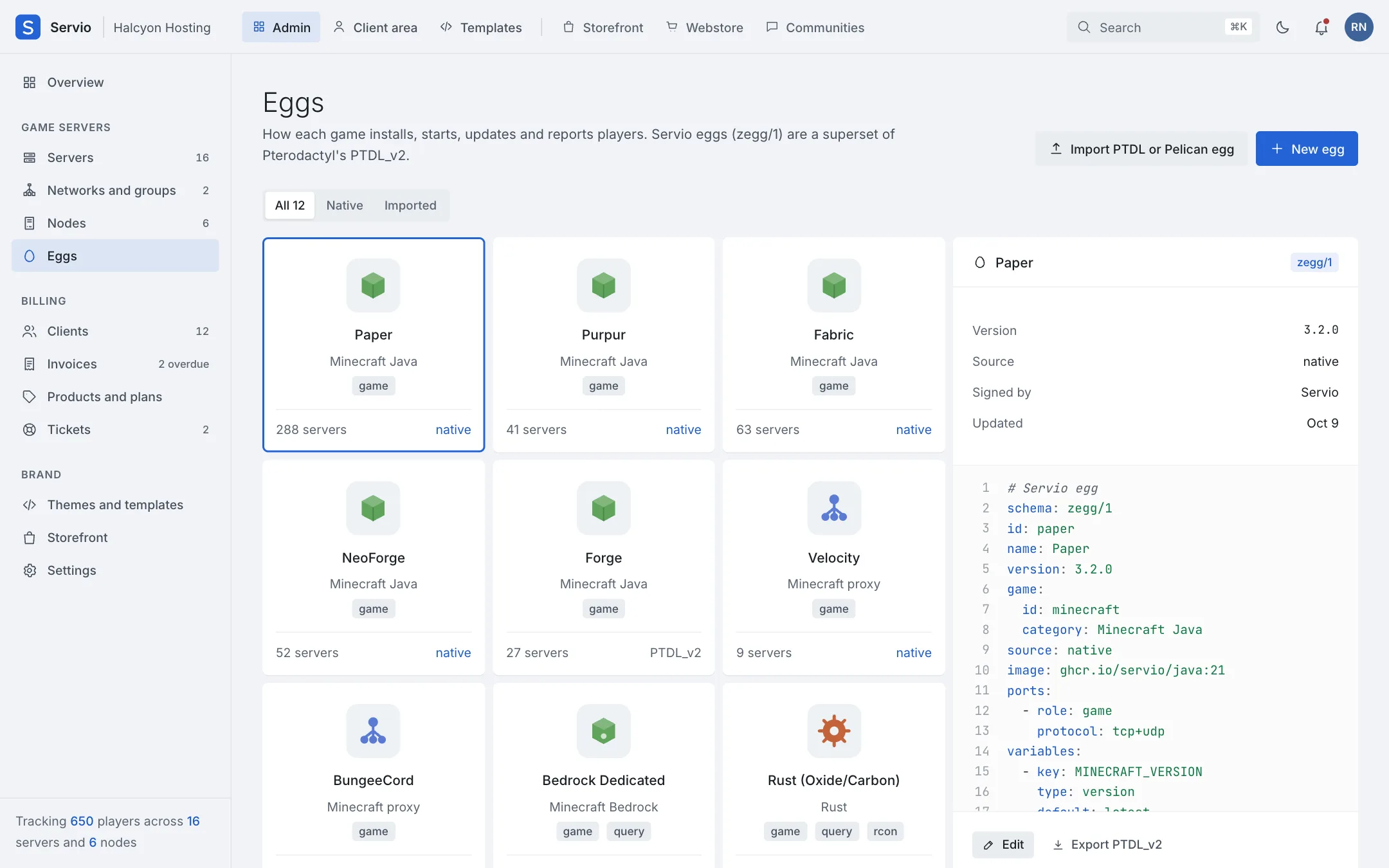
How a game installs, starts, updates and reports players. Ours is a superset of Pterodactyl's.
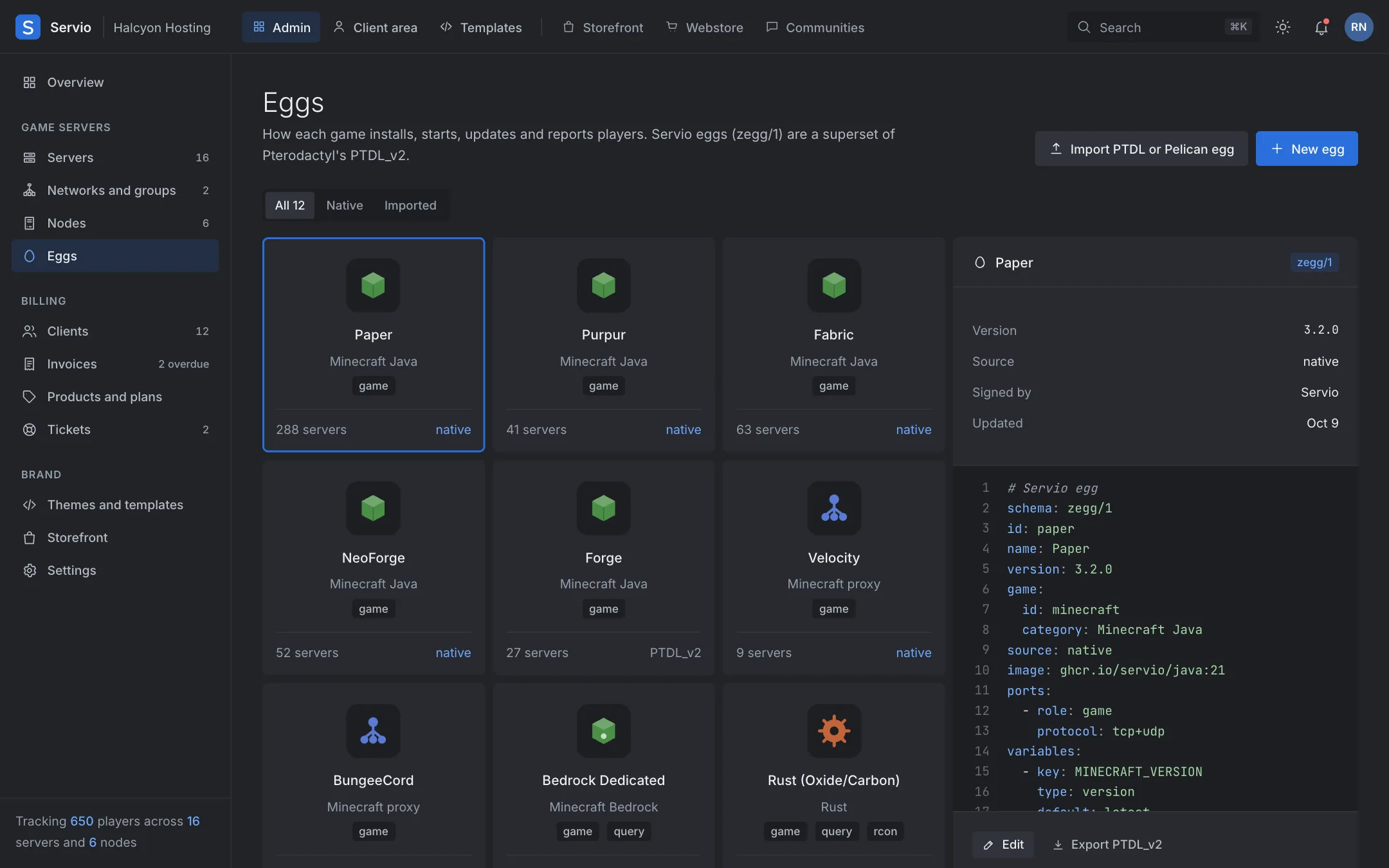
  • YAML or JSON with a published schema, so your editor autocompletes and CI validates.
  • Typed variables with ranges and choices, which clients may edit and which plans may sell.
  • Port roles (game, query, RCON, voice) so allocations, the firewall and addresses know what each port is for.
  • Several install steps, an update step with no reinstall, and console rules for "player joined" and "server ready".
  • Imports PTDL v1, PTDL v2 and Pelican's PLCN v3, with a report of anything that didn't map. Exports back to PTDL v2.
  • Install scripts are shown for review before their first run, and run in throwaway containers.
An egg's definition in YAML with typed variables and port roles.An egg's definition in YAML with typed variables and port roles.

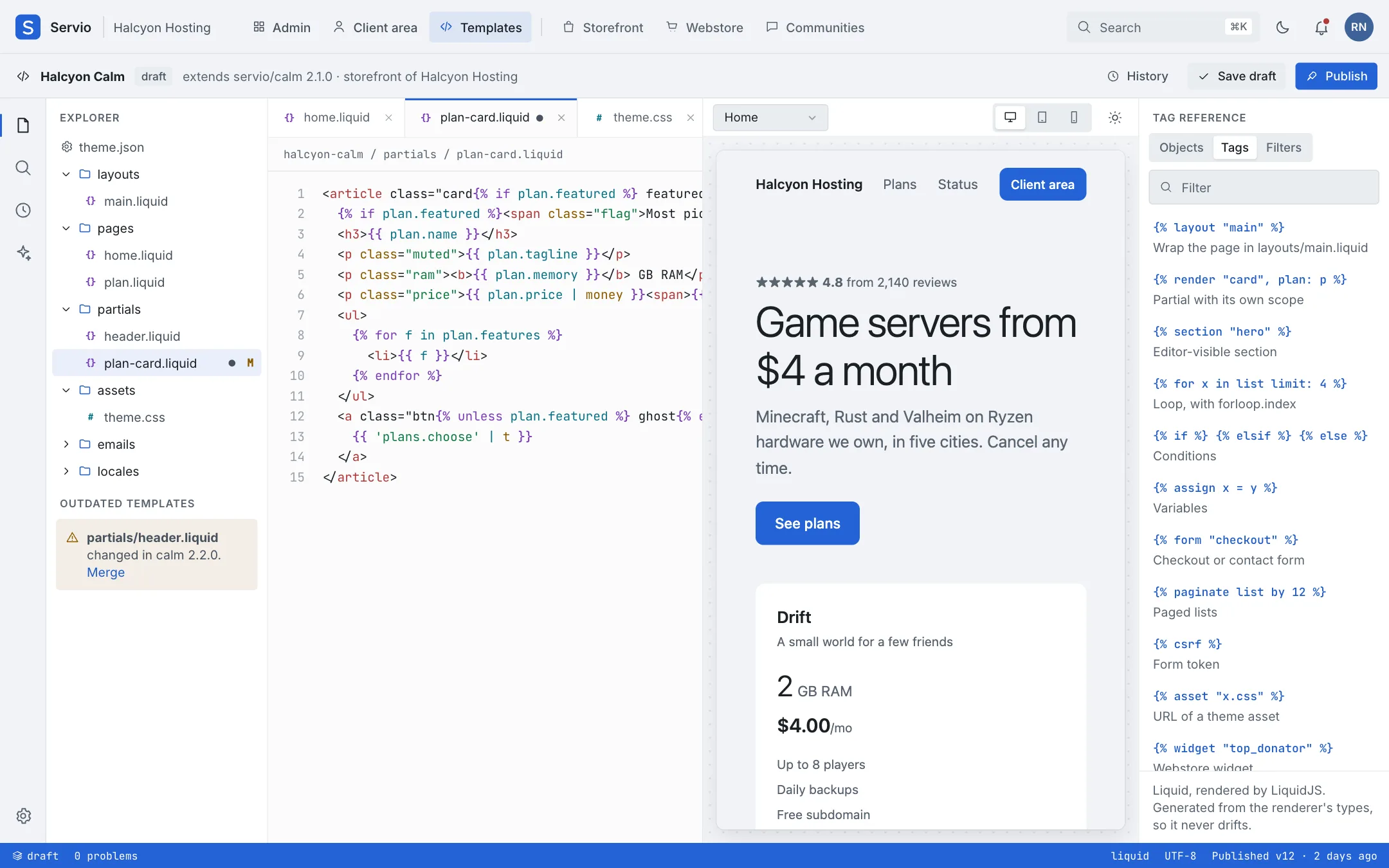
Themes and the template editor

Every page of the storefront, client area, webstore and forums is a template you can edit.
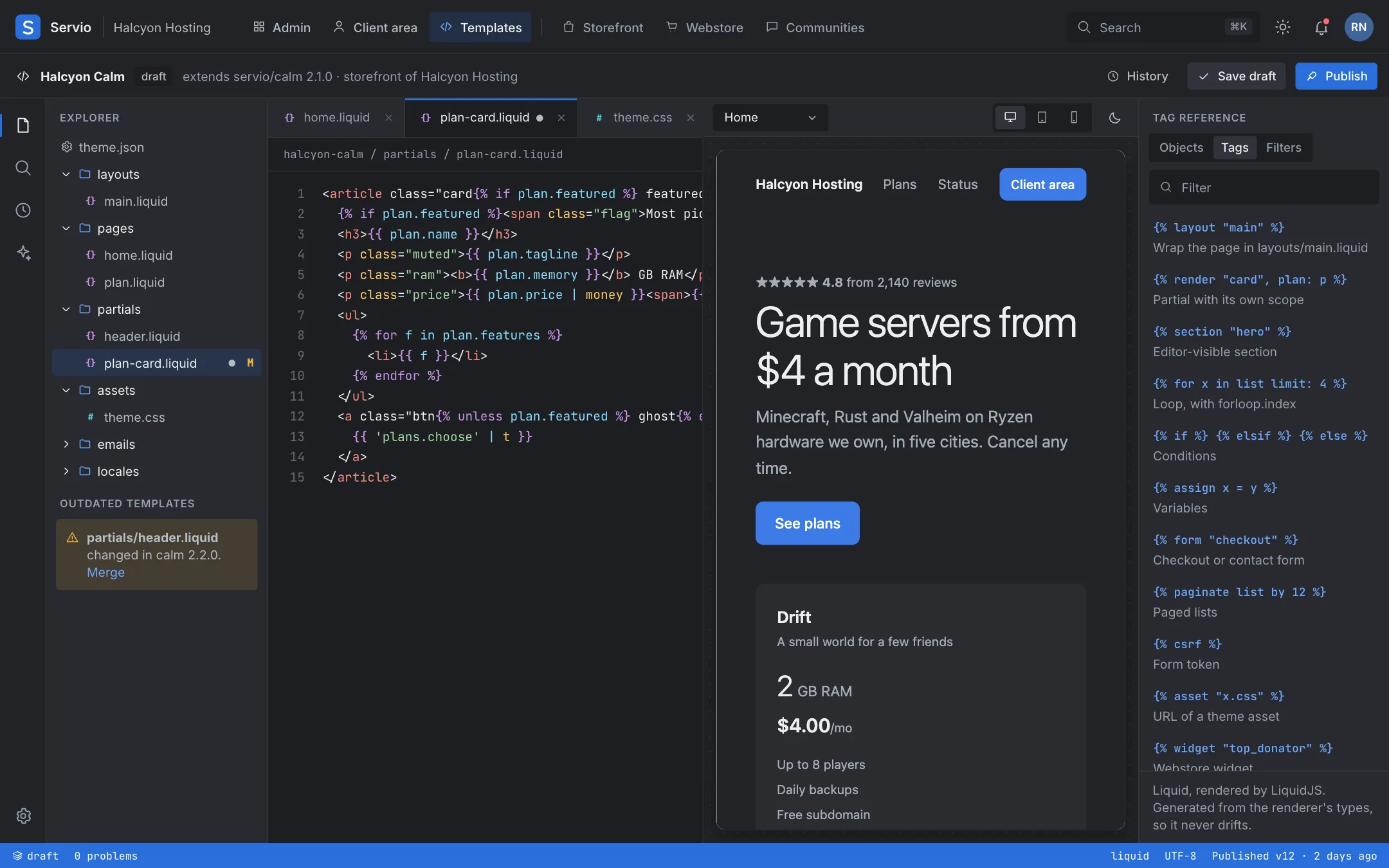
  • Liquid templates, sandboxed by design, with our objects, tags and filters documented in full.
  • An editor laid out like the code editor you know: file tree, tabs, quick open, search and autocomplete.
  • Live preview at desktop, tablet and phone sizes, in light and dark.
  • Drafts, versions with messages, and one-click restore. Theme updates show a three-way merge for files you changed.
  • A "Customize" panel for colors, fonts and logo, with no code.
The template editor: file tree, a Liquid template, live preview and tag reference.The template editor: file tree, a Liquid template, live preview and tag reference.

API, webhooks and MCP

REST API v1

An application API for staff keys with scopes and a client API for each client's own services. OpenAPI 3.1, a typed client, idempotency keys. Stable for all of 1.x.

Webhooks

Orders, invoices, servers, tickets, store and forum events. Signed over the body and a timestamp so they can't be replayed, retried with backoff, with a delivery log.

MCP server

Let an AI assistant read and edit your templates as drafts, check a server or look up an invoice, with scoped tokens. Anything destructive waits for your confirmation.

We take no fees. You only pay your payment provider. Money goes from your buyer, through your own Stripe or other gateway account, straight to you.

Run it your way.

Free for personal use, one payment to sell. Try the demo in your browser, or install Servio on your own machine in one line.